Section properties calculator
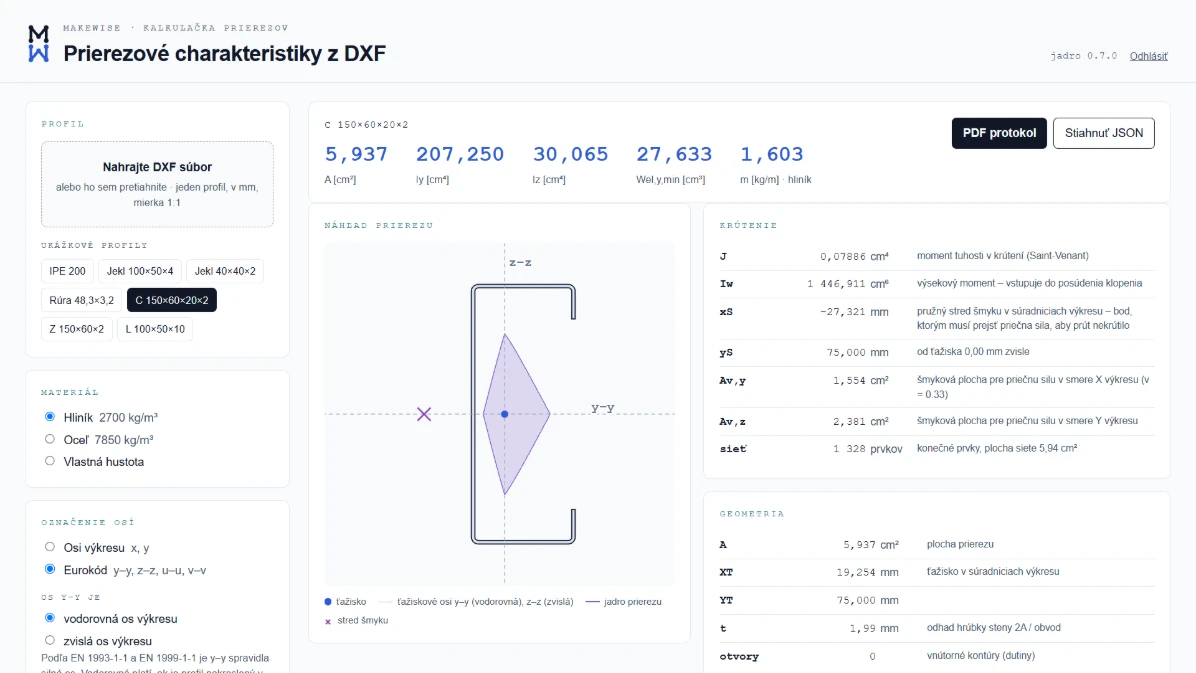
A custom application: from a DXF drawing it computes area, second moments of area, section moduli, the core of the section and the torsion constant. Output as a PDF report and JSON.
Engineering analysis
Finite element analysis (FEA) establishes whether your structure holds — and we back it with a report that stands up in front of your customer. We do not bend off-the-shelf software to your problem; where it makes sense, we build the solution for the problem itself.
Companies and institutions we have worked at or collaborated with.
Where it hurts
Prototyping is slow and expensive — every iteration costs time and money.
Our structures fail earlier than they should.
A customer or a standard wants the calculation documented — and we have no analyst of our own.
Structural, thermal and flow analyses including verification and interpretation with engineering depth.
Custom models and algorithms for problems that off-the-shelf software cannot handle.
Connecting systems and removing manual steps in production and administration — from shop-floor data capture through reporting and material orders to preparing documentation and reports.
Predicting maintenance, material consumption and stock levels — decisions grounded in data, not guesswork.
Processing and analysis of measurements and operational data — from cleaning to an interpretable result.
ML surrogates that replace an expensive computation with an orders-of-magnitude faster prediction at verified accuracy.
Selected work

A custom application: from a DXF drawing it computes area, second moments of area, section moduli, the core of the section and the torsion constant. Output as a PDF report and JSON.

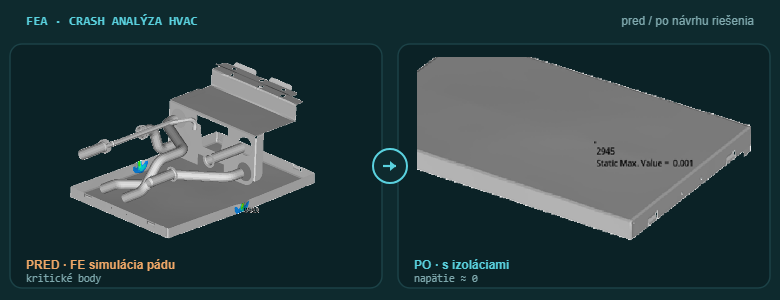
Full analysis of an HVAC unit drop test — prediction of the critical points of the structure and a proposed fix. Verified against the physical test.

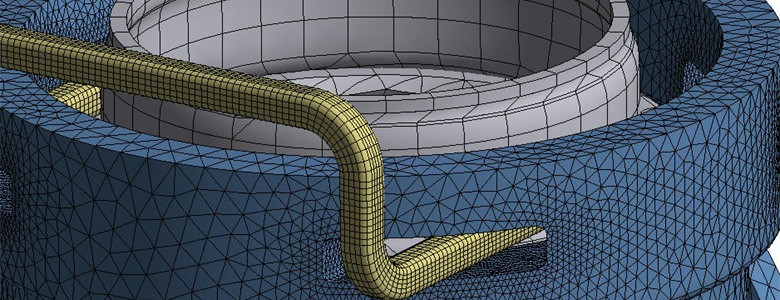
The valve kept cracking at the same place in the pressure test. A non-linear analysis with a submodel compared the design options and picked the one that holds.

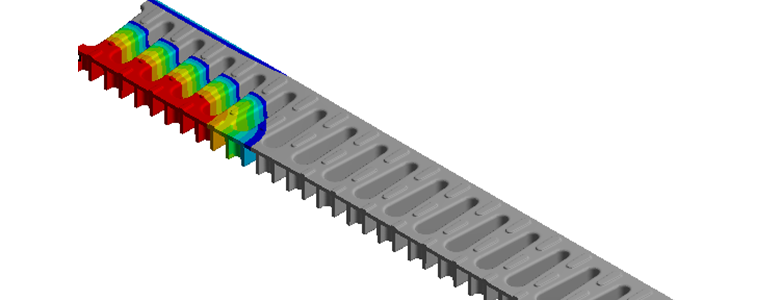
Seven rib layouts compared in three-point bending. Failure was governed not by stress but by plastic strain at the tensile peaks.

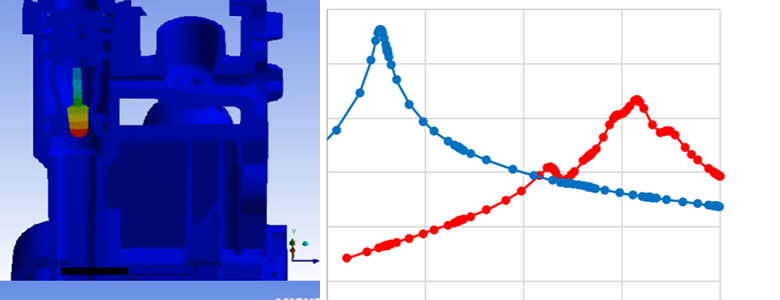
The unit whistled in one particular position. Sound analysis and a modal analysis found the mode responsible — a geometry change moved the resonance out of the operating range.

An ML surrogate for the FEM analysis — 65 ms to 1.1 ms at a 0.006% deviation.
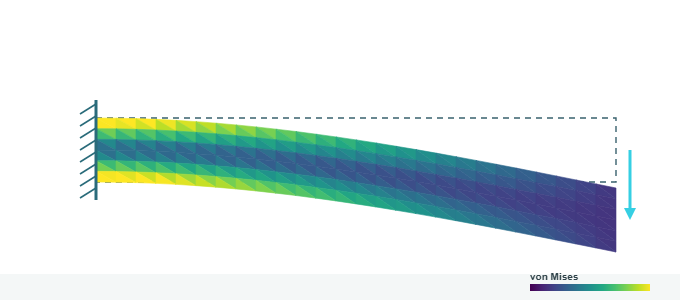
Move the force and its direction and watch the beam deflect. The surrogate model computes the displacement field right here in the browser, with the exact FEM solution alongside for comparison. It is a deliberately trivial case: it demonstrates the principle of a surrogate model, not a claim that any computation can be replaced this way.